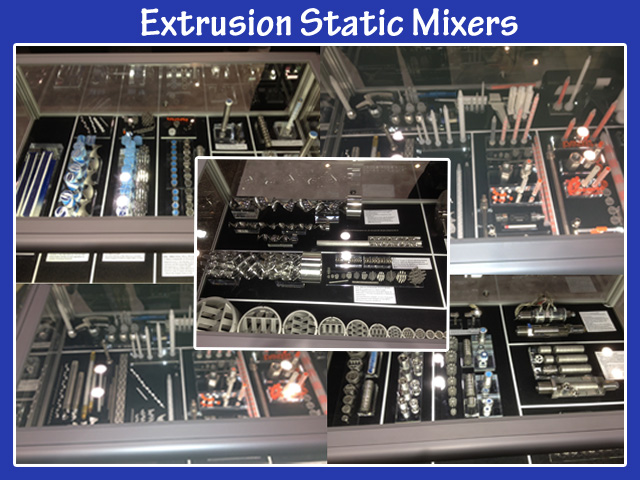
Extrusion - Extruder Mixing-Mixer
Static Mixer
|
Extrusion (Extruder) Mixings and Mixers
EQUIPMENT FOR STATIC MIXING & REACTION TECHNOLOGY
StaMixCo Technology Ltd
World-Wide Distributor For Extrusion Static Mixers
StaMixCo Technology Ltd. designs and manufactures static
mixers for selected and sophisticated
process engineering applications.
Established in 2003 in Neftenbach, Switzerland, StaMixCo Technology Ltd. and its experts rely on many decades of experience and know-how in the fields of static mixing and reaction technology. The design of the mixers is based on a licence of the Double-Roof Disk Static Mixer Technology of Bayer AG, Germany.
We specialize in static mixers for laminar flow applications such as the homogenization of polymer melts in plastics processing injection molding and extrusion equipment, mixing/dispersing in polymer production (viscous/viscous and high/low viscosity materials) , and heaters/coolers for laminar flow applications.
Sales and customer service for our static mixers is provided and supported
by a network of partners and distributors in Europe, America and Asia.
Double-Roof Disk Static Mixer
The static mixer with a fascinating scale-up concept
for polymer mixing
- for static mixing and dispersion in laminar flow
- high viscous mixing
- low viscous mixing
- high/low viscosity mixing/dispersion
- for creating plug-flow conditions in reactors
SMN Mixing Nozzle and Filter SMF
The static mixer solution for melt homogenization in INJECTION MOLDING
SMB-R Melt Blender
The static mixer solution for melt homogenization in EXTRUSION
GXM Mixing Elements
The solution for MIXING/DISPERSING of fluids of similar or
very different viscosity
stamixco....mix it up
SMB Extrusion Melt Blender
Colorant, Thermal & Compositional
Melt Homogenization
mixing equipment with no moving parts for the extrusion of viscous polymers, resins, foods and other materials
INTRODUCTION
StaMixCo manufacturers all three commercially proven static mixer designs used for extrusion service (see page 3). As with most pieces of process equipment, each static mixer design has specific advantages and disadvantages that make it more or less suitable for a specific application and installation.
The Static Mixer Melt Blender (Figure #1) is installed just in front of the extruder die. It is installed as the last piece of equipment to correct all irregularities created by the extruder screw, empty piping and downstream auxiliary equipment such as screen changer and gear pump. In some applications such as multi-layer film, small diameter mixing elements are installed within the die flow channels,
The Static Mixer Melt Blender contains no moving parts. Molten polymer, driven by the screw, flows through the static mixer as it enters the die. The static mixer homogenizes the melt in a remarkably short length by continuously dividing and recombining material flowing through its geometric structure. In virtually all applications, the Melt Blender can accommodate the length and pressure drop constraints of the extrusion system.
Process Improvements
The fundamental process improvement that a static mixer creates is the optimization of conditions of the molten polymer at the face of the die. This allows for an improved extruded product. The process improvements are:
Radial temperature gradients are virtually eliminated.
Viscosity gradients are virtually eliminated.
Composition gradients are virtually eliminated with regards to colorant, chemical additives, fillers and regrind.
Stagnant polymer wall-creep material is incorporated into the bulk polymer stream.
Operating Benefits
A static mixer creates outstanding homogenization of the polymer melt at the face of the die. With the polymer melt being homogeneous with regard to temperature, viscosity, colorant/additive distribution and elimination of wall-creep material, the following operating benefits are realized:
Reduction of color additives with comparable extrudate color density.
Even thickness across the entire extrudate width.
Streak-free product.
Improved quality when using regrind material.
Foam cell size and cell distribution uniformity.
Improved surface quality
Improved mechanical characteristics.
Rapid color change-over.
Extrusion Applications
Static Mixers are used in most extrusion applications including the following:
Sheet • Extrusion Blow Molding
Blown Film • Rod & Tubing
Foam sheet • Wire & Cable
Profile • Coatings
Co-Extrusion • Cereals and other foods
Pipe • Fibers & Monofilaments
STATIC MIXER MELT BLENDER
Figure #1: The Static Mixer Melt Blender is installed just in front of the die to homogenize the polymer melt.
EQUIPMENT SCOPE OF SUPPLY
As with most process equipment, there is no one design that is best suited for all applications. Static Mixers are no exception to this general rule.
For this reason, StaMixCo manufactures a broad range of static mixer designs of different geometric structures. This allows us to make an unbiased recommendation as to which design is best for a specific application.
Below is a short guide that may help you identify the static mixer best suited for your particular application and needs. We have taken the liberty of our previous experience to create the below broad-stroke comparison. If you wish to discuss any of the statements, please do not hesitate to contact us.
The remainder of this brochure discusses the details of each design.
COMPACTNESS COMPARISONS
Approximate Mixer Diameter Compared to Extruder Screw
— 75% of Extruder Screw?Diameter
— 100% of Extruder Screw?Diameter
— 50% of Extruder Screw?Diameter
Length-to-Diameter ratio Required to Create a Mixing Quality Coefficient of Variation of 0.2 (80% mixed)
L/D = 4
L/D = 4
L/D = 18
HOMOGENEITY REQUIREMENTS FOR EXTRUSION SERVICE
In extrusion service, the fundamental purpose of a static mixer is to create a homogeneous polymer melt at the face of the die. This includes:
Temperature Homogenization.
Viscosity Homogenization.
Composition Homogenization of colorants, chemical additives, regrind and fillers.
Self-Cleaning and Homogenization of irregularities created by upstream equipment such as: extruder screw & piping colorant hang-up release material; gear pump teeth footprints; and incorporation of flaked wall-creep degraded polymer hang-up.
Achieving the above optimized polymer melt conditions at the die face dramatically improves extrusion operations, product quality and consistency.
Temperature & Viscosity Homogenization
An extruder screw is an effective specialty device for creating high shear to plasticize pellets, incorporate additives and supply a polymer melt at a pressure necessary for further processing. As shown in Figure #2, the extruder screw unfortunately delivers the molten polymer with a very wide temperature gradient of about 40 F° (blue line).
LTA : Typical 22C° (40 F°) Barrel Temperature Profile
._T2: Typical 2C (3 Fl Static Mixer Exit Temperature Profile
Figure #2: An extruder screw (blue line) typically delivers molten polymer with a high temperature gradient which effects product quality. The Type SMB-R and SMB-GX mixing elements reduce the temperature variation to less than 3 F° (purple line).
Viscosity gradients are a result of temperature gradients. Once the static mixer creates a melt with a relatively flat radial temperature profile, viscosity gradients will also be eliminated.
Temperature and viscosity gradients cause uneven flow conditions at the die face. For example, let us consider a sheet line with polymer exhibiting the typical temperature profile noted in Figure #2. Without the use of a static mixer, uneven sheet thickness will result as described below and in Figure #3.
Where polymer temperature is low, polymer viscosity is high. This means that at the low temperature (TLT) polymer positions at the die, the sheet will extrude thin because flow is low due to the high viscosity polymer.
Where polymer temperature is high, polymer viscosity is low. This means that at the high temperature (THT) polymer positions of the die, the sheet will extrude thick because flow is high due to the low viscosity polymer?111
?High Temperature I—I Polymer Melt (THT) Low Temperature Polymer Melt (Tur)
Figure #3: Polymer melt temperature gradients at the die result in sheet thicknesses that vary.
Elimination of temperature gradients with the use of a static mixer (Figure #4) will allow the extrusion of a sheet with even thickness along the entire width. In foam sheet applications, additional benefits include even foam cell size and even distribution of foam throughout the entire sheet.
Homogenization & Self-Cleaning
There are three fundamental flow regimes associated with the movement of fluids: turbulent, transitional and laminar flow. The flow regime that a fluid in motion falls within is a function of the viscosity, density, velocity and pipe diameter. The movement of low viscosity fluids such as water and gases is normally in the turbulent flow regime where mixing occurs as a result of the pattern of motion of fluids in turbulent flow. Given a long enough length of pipe, fluids traveling in turbulent flow will mix very well.
SMB-R Static Mixer Melt Blender
The standard SMB-R static mixer for extrusion service (licensee of Bayer AG, Leverkusen, Germany) contains eight (8) very efficient mixing elements that homogenize the polymer melt as it enters the extruder die. The mixing elements are virtually indestructible due to their monolithic cast construction and create an acceptable pressure drop to fit most installations.
Figure #10: StaMixCo SMB-R Extrusion Melt Blender with the standard eight (8) Mixing Elements, Flanged Housing, Heater Bands and Thermocouple.
Figure #11: The SMB-R mixing elements are extremely strong due to their monolithic cast construction where the mixing bars are joined to each other and to the ring wall via a single molten metal pour.
The SMB-R mixing element is a high performance design. It creates a very high degree of mixing in a short length as shown in Figure #12. The recommended number of mixing elements for a specific application is as follows:
Four (4) mixing elements for mild thermal homogenization (L/D = —2).
Standard eight (8) mixing elements for compositional and thermal homogenization (L/D = —4.0).
Twelve (12) or more mixing elements for critical mixing and thermal homogenization applications (L/D = —6).
Figure #12: Blue and White resin (1:1 volumetric ratio) is pumped through a total of sixteen (16 -SMB-R mixing elements, allowed to harden and cross-sectional cuts are made at the outlet of each mixing element. Notice how quickly the streams are mixed and that adjacent mixing element blades are oriented 90° to assure mixing over the entire pipe cross-section. Depending on the application, the number of mixing elements required normally range from four (4) mixing elements (L/D = —2) for mild thermal homogenization requirements; the standard eight (8) mixing elements for most compositional and thermal homogenization requirements (L/D = —4.0); and twelve (12) mixing elements (L/D = —6) for critical applications requiring a very high degree of mixing.
SMB-R Static Mixer Sizing
The proper size SMB-R Melt Blender for a specific application is a function of the available pressure drop; degree of mixing required and polymer flow rate and viscosity at the operating conditions. For most applications, Table #1 provides a conservative estimate of required static mixer size based on extruder screw diameter and high or low viscosity polymer being processed.
The standard SMB-R Extrusion Melt Blender contains 8-mixing elements as shown in Figures #13 and #14 with key dimensions shown in Table #1. The mixing elements are made of heat treated high strength 17-4 PH stainless steel material
TOT
Figure #13: Dimensions of eight (8) SMB-R mixing elements. See also Figure #10, #11 and #12 for visualization.
The mixing elements easily disassemble from one-another for inspection or cleaning as shown in Figure #10 and #12.
For pressure drop critical applications; the processing of specialty engineering plastics we are not familiar with; or for mixer installations inside of die blocks, we have the know-how to properly size the mixing unit. To perform the necessary design calculations, polymer rheology information (shear rate vs. viscosity at operating conditions) is required. If you or we feel that your application requires special calculations, we will contact your resin supplier with your permission and manage the effort of obtaining the necessary technical information to perform the detailed calculations.
All sizes in stock for next day shipment
The O.D. of the mixing elements can be adjusted.
SMB-GX Static Mixer Melt Blender
The standard SMB-GX static mixer for extrusion service contains four (4) very efficient mixing elements that homogenize the polymer melt as it enters the extruder die.
The Type SMB-GX static mixer (StaMixCo version of the Sulzer Chemtech SMX Static Mixer)*, is a design that has been in use on extruders for over 25 years. It has the same fundamental crossing-bar structure as the StaMixCo SMB-R static mixer (Figure #11 and #12), but without the support ring around the mixing blade structure which gives the SMB-R its remarkable strength. The SMB-GX mixing grid design creates a very high degree of mixing in a short length. Since it is manufactured from metal plates that are welded together, virtually any plate thickness can be used and any mixer diameter can be fabricated to meet installation requirements.
Figure #15: StaMixCo SMB-GX Extrusion Melt Blender mixing elements with the standard four (4) Mixing Elements shown with and without a retaining ring.
Figure # 16: Type SMB-GX mixing elements are available in sizes as small as 10 mm (0.40') for installation inside extrusion dies and other small cavities.
The SMB-GX mixing element is a high performance design. It creates a very high degree of mixing in a short length as shown in Figure #17. The recommended number of mixing elements for a specific application is as follows:
Two (2) mixing elements for mild thermal homogenization (L/D = -2).
Four (4) standard mixing elements for compositional and thermal homogenization (L/D = -4.0).
Six (6) or more mixing elements for critical mixing and thermal homogenization applications (L/D = -6+).
* StaMixCo is not a distributor of, authorized by or affiliated with Sulzer Chemtech. SMX is a brand of Sulzer Chemtech.
SMB-GX Static Mixer Sizing
The proper size SMB-GX Melt Blender for a specific application is a function of the available pressure drop; degree of mixing required and polymer flow rate and viscosity at the operating conditions. For most applications, a conservative estimate of required static mixer size is matching it to the extruder screw diameter.
The standard SMB-GX Extrusion Melt Blender contains 4-mixing elements as shown in Figures #18 with key dimensions shown in Table #2. The mixing element sizes are made of heat treated high strength 17-4 PH stainless steel material.
For pressure drop critical applications; the processing of specialty engineering plastics we are not familiar with; or for mixer installations inside of die blocks, we have the know-how to properly size the mixing unit. To perform the necessary design calculations, polymer rheology information (shear rate vs. viscosity at operating conditions) is required. If you or we feel that your application requires special calculations, we will contact your resin supplier with your permission and manage the effort of obtaining the necessary technical information to perform the detailed calculations.
Figure #19: The SMB-H static mixers shown above are machined from a solid rod of round bar stock material, in one piece and without welding. The machining process allows any L/D twist to be supplied. The second static mixer from left is L/D=0.7; the fourth static mixer from left is IJD = 1; and the remainder are L/D = 1.5.
SMB-H Static Mixer Melt Blender
The Type SMB-H Helical static mixer (StaMixCo version of the Kenics Thermogenizer Static Mixer)*, is the design that pioneered the static mixing industry and has been used on extruders for over 37 years. The SMB-H helical design is considered a low mixing performance-long length static mixer design (Figure #20) as compared to the later developments of high performance static mixers such as the SMB-R (Figure #12) and SMB-GX (Figure #17) static mixer designs.
The SMB-H continues to remain a popular design for simple low-demand applications because it exhibits a low pressure drop; imparts low shear on the polymer; can be highly polished at reasonable cost; has a low surface area exposed to the polymer; is easy to clean; difficult to crush; and allows for installation in small cost effective diameters with a reasonable pressure drop. With pressure drops of approximately 6-times an open pipe, as compared to 36-times an open pipe for the high performance static mixers, the design continues to be popular for simple mixing requirements.
StaMixCo manufactures SMB-H static mixers in the traditional method of twisting a strip of metal and welding together as well and an advanced proprietary manufacturing technique where it is machined from a solid rod of round bar stock material without welding. This machining process allows for the mixer to be fabricated in any L/D twist, in very small sizes, with very high strength, straight and true dimensioning and to have a mirror polish surface finish of RMS 12 which is a much improved surface finish as compared to the traditional 32 RMS finish.
Figure #20: Blue and white viscous resin (1:1 volumetric ratio) is pumped through six (6) SMB-H static mixing elements, allowed to harden and cross-sectional cuts are made at the outlet of each mixing element. The SMB-H static mixer is considered a low performance mixing device of long length and is therefore used for non-demanding applications. Compare the SHB-H low degree of mixing to the high performance SMB-R (Figure #12) and SMB-GX (Figure #17) static mixers. The SMB-H however has a very low pressure drop that allows it to be used in smaller diameters for the same extruder screw size.
* StaMixCo is not a distributor of, authorized by or affiliated with Kenics Corporation. Thermogenizer is a brand of Kenics Corporation.
SMB-H Static Mixer Sizing
The proper size SMB-H Melt Blender for a specific application is a function of the available pressure drop; degree of mixing required and polymer flow rate and viscosity at the operating conditions. For most applications, a conservative estimate of required static mixer size is half the extruder screw diameter.
The SMB-H is available in 316L S/S material and is available in standard configurations of:
6-helical mixing elements with a twist of L/D=1.5
9-helical mixing elements with a twist of L/D=1.0
Any twist L/D is available as tight as approximately 0.7 with the machined version of the helical mixer.
SMB-H static mixers with 6-helical mixing elements having an L/D = 1.5 twist are the preferred choice for thermal homogenization and 9-helical mixing elements of L/D = 1 twist are preferred for equalization of concentration, color and additive homogenization. The pressure drop of an SMB-H Melt Blender depends on the number of helical mixing elements and their L/D ratio. A unit with L/D = 1.5 helical twist has a lower pressure drop than a unit with L/D = 1 helical twists.
Standard 6-element units with L/D = 1.5 twist are shown in Figure #21 and Table #3. Standard 9-element units with L/D = 1 twist are shown in Figure #22 and Table #4.


